ULTRAMAX 12V 6Ah Battery: Product Overview
Can a compact 12V lithium battery genuinely improve on a conventional 7Ah or 8Ah lead-acid unit? The ULTRAMAX 12V 6Ah Battery makes a credible case for low-to-moderate-current backup equipment, mainly through its LiFePO4 chemistry, maintenance-free design, and advertised 4000+ cycle life. It is less convincing as a universal replacement for demanding motors or inverter systems, where the 10A protection limit may become the deciding factor.
The ULTRAMAX 12V 6Ah Battery is a mini deep-cycle battery intended for CCTV cameras, solar storage, fish finders, lighting, pumps, UPS equipment, alarm systems, outdoor radios, trolling motors, lawn mowers, and emergency power. The product description lists a 90mm x 70mm x 106mm body, a 2kg weight, a built-in 10A battery management system, and more than advertised deep-cycle recharge cycles.
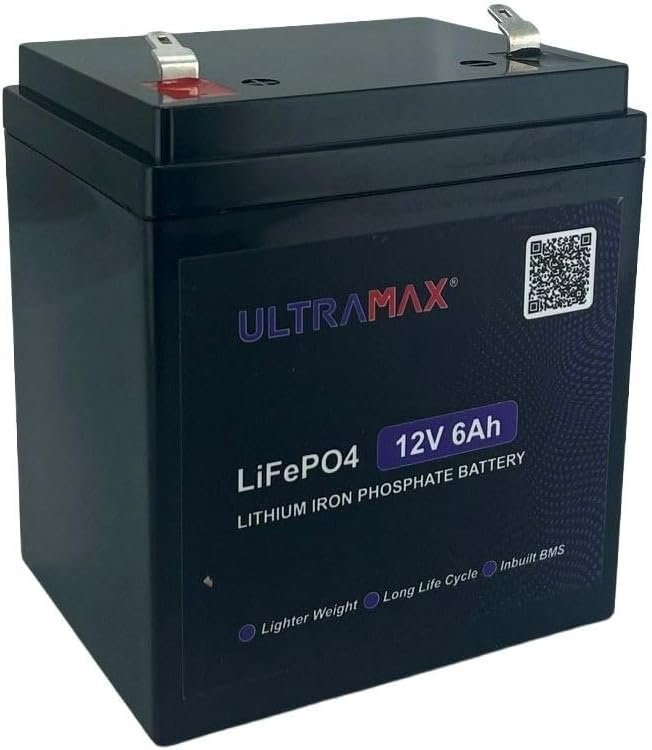

ULTRAMAX 12V 6Ah Battery Specifications at a Glance
The core specification points to a small 12V LiFePO4 pack aimed at backup and light portable duties. The table below keeps the advertised figures together so we can assess compatibility without confusing nominal capacity with guaranteed runtime.
| Specification | Advertised detail |
|---|---|
| Nominal voltage | 12V |
| Capacity | 6Ah |
| Chemistry | LiFePO4, or lithium iron phosphate |
| BMS rating | 10A |
| Claimed cycle life | More than deep cycles |
| Dimensions | 90mm L x 70mm W x 106mm H |
| Weight | 2kg |
| Charging temperature | 0°C to 50°C |
| Discharging temperature | -20°C to 55°C |
A 6Ah rating describes electrical capacity, not a fixed number of operating hours. A rough energy estimate starts with voltage multiplied by amp-hours, but actual runtime changes with the device’s wattage, conversion losses, temperature, battery age, and the BMS or charger stopping discharge before every last unit of stored energy is used.
The product is physically compact but weighs 2kg, so it may suit a small fixed backup enclosure better than equipment carried all day. Before connecting the ULTRAMAX 12V 6Ah Battery, check the equipment manual for voltage, connector polarity, terminal arrangement, maximum current, and charging compatibility. The ULTRAMAX 12V 6Ah Battery is only a suitable replacement when those electrical details match, not simply because both products are described as “12V.”
Key Features Deep-Dive: LiFePO4 Chemistry and 4000+ Cycles
LiFePO4 is commonly chosen for stationary and deep-cycle applications because it offers a stable battery chemistry, consistent voltage delivery, and low routine maintenance. The ULTRAMAX 12V 6Ah Battery also avoids the watering and acid-handling tasks associated with traditional flooded lead-acid batteries, which is useful when a battery sits inside a CCTV cabinet, alarm enclosure, or remote solar installation.
The advertised cycle figure is the standout claim: more than deep cycles, compared with the stated 300-400 cycle range for lead-acid batteries. That difference could reduce replacement frequency, but cycle life isn’t a guaranteed calendar result. Depth of discharge, charging quality, storage conditions, temperature, and how frequently the battery cycles all affect the outcome.
The description also claims more than years of service life. We would treat that as a manufacturer estimate rather than a promise for every installation. A shallow-cycled backup battery stored correctly may fare very differently from one repeatedly discharged near its limit.
To size the ULTRAMAX 12V 6Ah Battery, first find the connected device’s wattage or measure its current draw. Multiply daily energy use by the required backup duration, then add capacity if that result approaches the battery’s usable limit. For a CCTV system, this calculation is usually more informative than simply matching the old lead-acid battery’s label.
For long-term cycling, the ULTRAMAX 12V 6Ah Battery is most attractive where maintenance access is difficult and predictable low-voltage storage matters more than a large energy reserve.
10A BMS Protection and Charging Safety
The built-in 10A battery management system is advertised as protecting against overcharge, over-discharge, over-current, and short circuit. That protection is valuable, but it doesn’t turn every 12V charger into a LiFePO4 charger. The ULTRAMAX 12V 6Ah Battery still needs a charging profile intended for lithium iron phosphate cells.
The 10A figure matters most when loads start suddenly. Pumps, trolling motors, UPS equipment, and inverter-fed devices may draw a short surge that is much higher than their normal running current. If that surge reaches the protection threshold, the ULTRAMAX 12V 6Ah Battery may disconnect even though the average load appears acceptable.
- Confirm positive and negative polarity before making any connection.
- Check both continuous current and startup or surge current for the load.
- Use a charger specifically designed for 12V LiFePO4 batteries.
- Inspect terminals, cables, connectors, and insulation for damage.
- Stop using the battery if it becomes swollen, unusually hot, or physically damaged.
Protection circuitry can disconnect the output when a limit is reached, potentially interrupting a camera recorder, alarm, UPS, or pump without much warning. The ULTRAMAX 12V 6Ah Battery therefore needs a setup that treats the BMS as a safety layer, not as a substitute for correct charger selection and load sizing.
Compact Design, Capacity Expansion, and Compatibility
The mini format is intended for tight enclosures, small backup systems, and portable electronics. It is marketed as a replacement for 7Ah and 8Ah lead-acid batteries, but that description doesn’t guarantee a drop-in fit. Terminal style, mounting orientation, cable reach, enclosure clearance, and heat management can all prevent a physically similar battery from working safely.
Before ordering the ULTRAMAX 12V 6Ah Battery, remove the existing battery or consult its installation diagram. Compare the terminals and cable positions, then check that the replacement can be secured without pressing against the case or placing strain on the wires. The ULTRAMAX 12V 6Ah Battery may be compact enough for a small cabinet, but compatibility remains an electrical and mechanical question.
The product information says up to four identical batteries may be connected in series and that parallel connection is supported without a stated maximum. Series wiring increases voltage; parallel wiring increases available capacity. Either arrangement must match the equipment’s requirements, and a mistaken series connection can damage 12V electronics.
When building a bank, use matching batteries with the same model, age, capacity, and charge state. Follow the manufacturer’s wiring guidance and don’t combine an old partially charged unit with a new battery simply because both are labelled 12V. Expansion makes the ULTRAMAX 12V 6Ah Battery more flexible, but it also increases the need for balanced wiring and careful commissioning.
Real-World Applications: CCTV, Solar, UPS, and Portable Equipment
Low-to-moderate-current backup loads are the clearest fit. CCTV cameras, alarm systems, outdoor radios, emergency lighting, and some small UPS installations generally benefit from a compact, maintenance-free storage battery. For these uses, stable energy delivery and reduced routine maintenance may matter more than maximum acceleration or motor-start performance.
Solar suitability depends on the whole system, not just the battery label. We would check the charge controller’s LiFePO4 compatibility, estimate daily consumption, calculate the desired nighttime autonomy, and decide whether a single small battery bank can cover cloudy-weather or outage needs. A 6Ah reserve may be adequate for a modest camera or lighting load but insufficient for several devices operating overnight.
Fish finders and portable radios are usually easier loads to assess because their current draw is often relatively steady. Lighting can also be suitable when its wattage is modest. Pumps, lawn mowers, trolling motors, and inverter systems are different: their starting or running currents may approach or exceed the BMS limit, so the product description’s list of applications shouldn’t be read as proof that every model in those categories will work.
For a practical estimate, take a 12W device and a desired 5-hour runtime: 12W multiplied by hours equals 60Wh before conversion and reserve losses. We would then compare that requirement with the battery’s usable energy and test the actual load if the result is close. The ULTRAMAX 12V 6Ah Battery is a better candidate for predictable backup than for a motor whose surge current hasn’t been measured.
In short, the ULTRAMAX 12V 6Ah Battery suits small installations best when the load profile is known. The ULTRAMAX 12V 6Ah Battery should be sized from measured demand, not selected solely because the product page names a particular device category.

What Customers Are Saying
The supplied product data does not include a live star rating, review count, verified-buyer comments, or individual customer experiences. We therefore can’t honestly claim that buyers praise its longevity, charge retention, compact fit, terminal compatibility, or CCTV performance. We also can’t report a reliable pattern of successful pump, motor, or UPS use.
That absence matters. Manufacturer statements about more than cycles and over years of service life are product claims, not customer evidence. For the ULTRAMAX 12V 6Ah Battery, we would check the live listing for recent detailed reviews that name the application, charger, runtime, and installation duration.
We would also look specifically for repeated complaints about BMS cutoffs, incompatible chargers, early capacity loss, damaged packaging, connector differences, or unclear instructions. One isolated comment shouldn’t outweigh a consistent pattern, but several detailed reports describing the same failure deserve attention before purchase.
At the time of writing, no rating or review volume was supplied for the ULTRAMAX 12V 6Ah Battery, so readers should not interpret this review as a positive or negative customer consensus. Prioritise recent comments with measured runtimes and named equipment over short reviews that discuss only delivery speed or appearance. That approach gives a more useful picture of whether the ULTRAMAX 12V 6Ah Battery fits your particular setup.
Who Should Buy This Battery?
The strongest match is a shopper needing a small maintenance-free battery for low-to-moderate-current CCTV, alarms, lighting, a fish finder, an outdoor radio, or emergency backup. It may also suit someone replacing a small lead-acid unit when the enclosure and terminals fit and the equipment can use a LiFePO4 charging profile.
Solar users should first calculate whether the available storage covers overnight operation or the expected outage period. A compact bank can work well for a modest load, but extended off-grid use may require more capacity or additional matched batteries. The ULTRAMAX 12V 6Ah Battery is not automatically suitable just because a solar controller accepts “12V” batteries.
We would investigate alternatives first for high-current motors, large inverters, extended off-grid loads, or equipment requiring a specific lead-acid charging profile. The advertised application list is broad, but actual suitability depends on current demand and startup surge.
Before purchasing the ULTRAMAX 12V 6Ah Battery, work through this checklist:
- Confirm continuous load current and startup surge.
- Confirm the charger is intended for LiFePO4.
- Match terminal arrangement and cable reach.
- Check enclosure clearance and secure mounting.
- Calculate the desired runtime rather than guessing from the Ah label.
- Decide whether a series or parallel expansion plan is needed.
This process makes the ULTRAMAX 12V 6Ah Battery a considered replacement rather than a risky like-for-like assumption.
Pros and Cons
Pros
- LiFePO4 chemistry is suited to repeated deep-cycle use and requires no routine watering.
- Advertised cycle life exceeds cycles, substantially above the stated 300-400-cycle lead-acid range.
- Compact mini format may fit small CCTV, alarm, lighting, radio, and emergency-power enclosures.
- Built-in 10A BMS is advertised with overcharge, over-discharge, over-current, and short-circuit protection.
- The product description supports series expansion with up to four identical batteries and parallel expansion, subject to manufacturer guidance.
Cons
- A 10A BMS may be limiting for pumps, trolling motors, lawn mowers, large inverters, and loads with high startup surges.
- No live star rating, review count, or individual customer comments were supplied, preventing a reliable customer-experience assessment.
- Physical replacement compatibility is not guaranteed; terminals, mounting, wiring, and charger requirements must be checked.
- The 4000+ cycle and 10-year service-life figures are advertised claims rather than guaranteed results for every installation.
Final Verdict
Key Takeaways
- The battery is designed for compact 12V LiFePO4 backup and light-duty deep-cycle applications, with an advertised 10A BMS and more than cycles.
- Its small format may suit CCTV, alarms, lighting, radios, fish finders, and modest solar storage, but motor and inverter loads need careful surge-current checking
- A LiFePO4-compatible charger, correct polarity, suitable terminals, and an electrical load below the protection limits are essential.
- The advertised 10-year service life and 4000+ cycles are manufacturer claims; actual results depend on charging, discharge depth, temperature, and storage.
Frequently Asked Questions
Are ECO-WORTHY lithium batteries any good?
They may be suitable for some applications, but quality and value depend on the specific model’s chemistry, BMS rating, warranty, charger requirements, and verified customer feedback. Check those details on the current listing rather than judging the entire brand from its name.
What is the best lithium battery for a motorhome?
The best choice depends on the motorhome’s daily energy use, inverter size, charging system, available space, and desired autonomy. A LiFePO4 battery is often considered for deep-cycle use, but buyers should match capacity, continuous current, surge capability, and charger compatibility to the installation.
What is the lifespan of an ECO-WORTHY battery?
Lifespan varies by model and depends on depth of discharge, charging, temperature, storage, and usage frequency. Use the specific product’s stated cycle-life and warranty information as a starting point, not as a guaranteed service period.
Are the Amazon lithium batteries good?
Some can perform well, but the listing should be assessed for chemistry, BMS protection, current rating, cycle-life evidence, warranty, and detailed recent customer reviews. Short reviews about delivery or appearance are less useful than comments reporting the actual load, charger, runtime, and time in service.
Disclosure: As an Amazon Associate, I earn from qualifying purchases.


