ECO-WORTHY 12V 30Ah Battery: Quick Overview
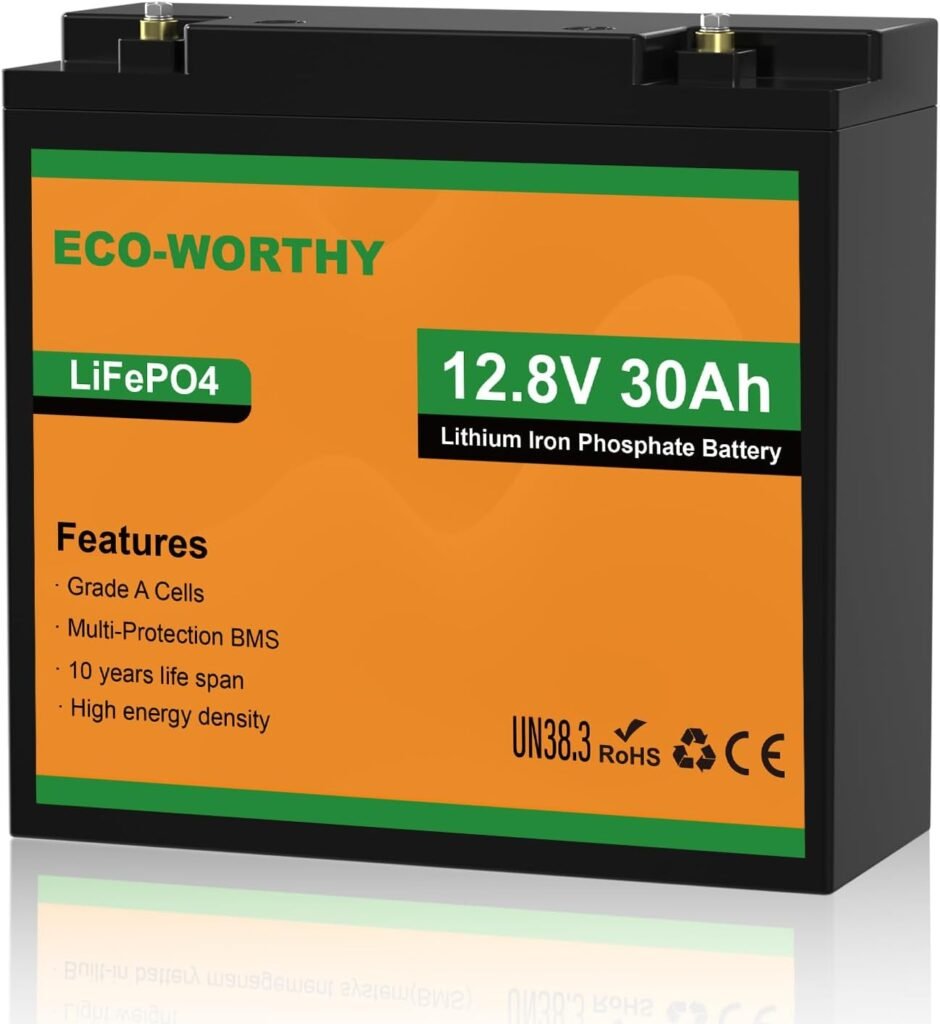
Can a compact lithium battery replace a much heavier lead-acid unit for modest 12V jobs? The ECO-WORTHY 12V 30Ah battery makes a credible case for buyers who value portability and repeated cycling more than maximum capacity in one box. It is a lithium-iron phosphate-style deep-cycle battery with an integrated Battery Management System (BMS), aimed at camping power, simple indoor setups, backup equipment, and similar applications.
The headline claims are substantial: a weight of 7.05 pounds, more than 4,000 cycles, and retention of 80% capacity after 3,000 deep cycles. Those figures come from the supplied product description, not an independently verified test. The supplied research also contains no star rating, review count, or individual verified-buyer excerpts, so we should treat the manufacturer’s claims and customer evidence as separate things.

Key Specifications and What They Mean in Practice
The 12V, 30Ah rating represents a nominal energy figure of approximately watt-hours, calculated as 12V × 30Ah. That is substantially less capacity than a common 100Ah leisure battery, which is nominally around 1,200 watt-hours at 12V. Actual runtime will depend on the appliance, wiring, inverter, state of charge, and the point at which the BMS disconnects the load.
To estimate runtime, divide watt-hours by the appliance’s wattage, then reduce the result for conversion losses and cutoff behavior. A 60W device might therefore appear to run for about six hours in a simple calculation, but that is not a guaranteed field result. Startup surges, inverter efficiency, battery condition, and continuous BMS current limits all matter.
The listed 7.05-pound weight is described as roughly one-third that of a comparable lead-acid battery. That can make a practical difference when carrying camping gear, fitting a small backup system, or working in a confined installation. The data does not provide exact dimensions, terminal type, operating-temperature range, waterproofing, or continuous discharge rating, so we should not assume any of those details.
- Confirm the physical dimensions and mounting space.
- Check connector and terminal compatibility.
- Match the charger to lithium chemistry and required voltage.
- Confirm that the inverter’s running and startup demand fits the battery.
- Verify the permitted installation orientation in the manual.
ECO-WORTHY 12V 30Ah Battery Features in Detail
The central ownership argument is cycle life. The product description says lead-acid batteries typically last about to cycles, while this lithium battery can exceed 4,000 cycles and retain 80% capacity after 3,000 deep cycles. If those claims hold in a particular installation, the longer replacement interval could offset a higher purchase cost and reduce the inconvenience of handling heavier batteries.
We should keep the figures in context. Cycle life changes with depth of discharge, charging habits, storage temperature, load, and how a manufacturer defines a complete cycle. A partial discharge followed by recharge may count differently from a full discharge, and the supplied information does not promise a specific number of calendar years.
The description also highlights low self-discharge. That is useful for seasonal camping equipment, emergency backup devices, and projects that sit unused between occasions. Compared with a conventional lead-acid setup, the appeal is a lighter battery with no stated routine watering requirement, although correct charging and storage remain necessary.
This creates the review’s main trade-off. The ECO-WORTHY 12V 30Ah battery offers claimed long-term cycling and easy handling, but its limited capacity makes energy planning essential, and owners need lithium-compatible charging equipment rather than simply reusing any older lead-acid charger.
BMS Protection: What It Covers and What It Does Not
The integrated Battery Management System is the battery’s protection and monitoring layer. The description lists protection against overcharging, deep discharge, overload, overheating, and short circuit, while also mentioning low self-discharge management. That protection is useful, but it is not a substitute for correct wiring, an external fuse, secure terminals, or a charger with a suitable lithium profile.
When a protection threshold is reached, the likely symptom is a sudden loss of output. Connected equipment may appear to fail even though the battery has not suffered permanent damage. The supplied information does not state the BMS continuous amperage limit, peak current, balancing method, reset behavior, or temperature cutoff thresholds, so we should not use this unit for a high-current load without confirming those figures.
For a careful installation, we would use cables sized for the expected current, fit appropriate circuit protection close to the battery, verify polarity with a meter, and keep demand within the documented battery limits. After the first high-load test, inspect terminals and cable ends for unusual warmth. A protected battery still needs a compatible lithium charger, and repeatedly forcing a cutoff can interrupt important equipment and reduce practical service life.

Charging the ECO-WORTHY 12V 30Ah Battery
The recommended ECO-WORTHY 12V 5A and 10A automatic smart chargers give a useful indication of charging speed. In ideal conditions, charging from empty could take roughly six hours at 5A or three hours at 10A. Real charging usually takes longer because of tapering, conversion losses, the battery’s starting condition, and the charger completing its automatic cycle.
A notable claim is that an ECO-WORTHY charger can activate the battery after BMS protection has fully engaged, restore normal voltage, and resume charging. That may be convenient after deep discharge, but it should not encourage repeated operation at the protection threshold. We would first investigate the cause of the cutoff rather than continually trying to wake the battery.
A lead-acid charger may use a profile that is unsuitable for LiFePO4 chemistry. Before connecting anything, verify the chemistry setting, output voltage, charging current, and connector polarity. A sensible first-use routine is:
- Inspect the case and terminals for damage.
- Confirm the charger settings against the manual.
- Connect the cables in the order specified by the manufacturer.
- Monitor the first charging session for abnormal heat or behavior.
- Disconnect or store the battery when the automatic cycle finishes.
We would follow the manufacturer’s manual for cold-weather charging, indoor storage, and long-term maintenance because no operating temperature limits were supplied. The product data also does not confirm that a charger is included, so we would treat the recommended charger as an additional purchase unless the live listing says otherwise.
Series and Parallel Expansion Explained
Identical batteries can be connected in series to raise voltage or in parallel to increase capacity, provided the manufacturer’s limits and wiring instructions are followed. The supplied example uses four matching units in a 2P4S arrangement: two batteries form one parallel group, a second pair forms another, and those two groups are then connected in series to create a 48V bank.
The stated limit is no more than four units per parallel string. Mixing different models, capacities, ages, charge levels, or condition can produce imbalance and uneven current sharing. That is particularly undesirable in a multi-battery bank because one unit may reach a protection threshold before the others.
For assembly, we would use matching batteries, bring them to similar charge levels, use equal-length cables for parallel connections, fit suitable fusing, and verify polarity at every stage. Measure each parallel group before connecting the complete bank. A 2P4S arrangement changes system voltage and total capacity, but it still needs a suitable 48V charger, inverter, disconnect, and overall battery-management plan.
The product information does not specify the maximum total bank size, recommended busbars, cable gauges, or communications features. Larger systems therefore need guidance from a qualified installer rather than relying only on the BMS label.
What Customers Are Saying About the ECO-WORTHY 12V 30Ah Battery
There is no supplied star rating, review count, or individual customer comment for this exact product, so we cannot honestly claim that buyers praise its runtime, charging behavior, or durability. The 7.05-pound weight, cycle-life figures, BMS functions, and expansion guidance all come from the product description rather than a customer-tested review sample.
When checking the live listing, the most useful reviews would report delivered weight and dimensions, initial voltage, charging behavior, runtime under a known load, terminal quality, BMS cutoff behavior, and capacity retention after months of use. A comment such as “works great” tells us very little without the appliance, current draw, charging method, operating temperature, and ownership period.
We would investigate repeated reports of premature shutdown, inconsistent capacity between units, charger incompatibility, damaged packaging, loose terminals, or difficulty waking the BMS. One isolated failure does not establish a product-wide fault, but the same specific complaint appearing across several recent reviews deserves attention.
- Filter for recent reviews of this exact 30Ah model.
- Compare the lowest and highest ratings.
- Look for repeated, technically detailed patterns.
- Separate shipping complaints from battery-performance complaints.
- Check whether reviewers identify their load and charging equipment.
Who Should Buy This 12V 30Ah Lithium Battery?
We would recommend the ECO-WORTHY 12V 30Ah battery mainly for buyers running modest loads who value portability. Camping accessories, small electronics, simple backup systems, and lightweight DIY projects are more natural matches than energy-hungry appliances. Its strongest case is an application where repeated cycling and easy handling matter more than getting the largest possible energy reserve from one unit.
Thirty amp-hours can suit short-duration use, but it may be limiting for refrigerators, large inverters, electric heaters, or substantial overnight demand. To match the battery to an application, calculate daily watt-hours, add a reserve for inverter losses and cold conditions, then compare the result with the nominal watt-hours. If the calculated demand is close to that figure, a larger battery bank would provide more practical margin.
Buyers planning an expanded system may appreciate the stated series-and-parallel support, provided they are prepared to use matched units and compatible balance-of-system parts. We would be cautious if we needed an included charger, a specified high-current output, Bluetooth monitoring, exact temperature ratings, or a clearly documented warranty and return policy.
In short, this model makes most sense for lightweight, moderate-demand cycling. It is less convincing as a one-battery answer for equipment that draws substantial power continuously.
Installation and Buying Checks Before Ordering
Before ordering, confirm the exact model name, live listing price, included accessories, return terms, warranty length, terminal hardware, and physical dimensions. Several of these details are absent from the supplied description, and they can affect whether the battery fits the project as planned.
- Calculate the load, startup demand, and expected runtime.
- Select a charger designed for the battery’s chemistry and voltage.
- Check inverter demand, cable sizing, fuse requirements, and disconnect arrangements.
- Verify the available mounting space and permitted orientation.
- Decide whether one battery is enough or a matched expanded bank is required.
We would also confirm that the connected device accepts the battery’s voltage and that its startup current does not exceed the battery and BMS limits. Internal protection cannot correct an unsuitable appliance or undersized wiring.
When the battery arrives, photograph the packaging, inspect the case and terminals, record the initial voltage, and test it with a known load before relying on it for emergency backup. Secure connections and appropriate external fusing remain necessary. For a purchase, the documented positives are the lithium chemistry, claimed cycling, BMS protection, low weight, and expansion option; the live listing must fill in the missing price, dimensions, limits, accessories, warranty, and temperature guidance.
Pros and Cons
Pros
- Light 7.05-pound design is easier to transport and install than a comparable lead-acid battery.
- Claimed service life exceeds 4,000 cycles, with 80% capacity stated after 3,000 deep cycles.
- Integrated BMS lists protection against overcharging, deep discharge, overload, overheating, and short circuit.
- Supports series and parallel expansion, including the described 2P4S 48V arrangement.
- Low self-discharge and no stated routine watering requirement suit seasonal or portable use.
Cons
- 30Ah capacity may be restrictive for refrigerators, heaters, large inverters, and substantial overnight loads.
- The supplied data omits exact dimensions, terminal type, continuous discharge rating, temperature limits, and BMS reset details.
- A lithium-compatible charger may be required, and the listing does not confirm whether one is included.
- No star rating, review count, or individual customer comments were supplied for independent buyer validation.
- The current purchase price, currency, warranty, and several installation details require confirmation on the live listing.
Final Verdict
Key Takeaways
- The ECO-WORTHY 12V 30Ah battery prioritizes low weight and claimed long cycle life over large single-unit capacity.
- Its 7.05-pound design and stated series/parallel support suit portable projects and expandable battery banks.
- The BMS lists several protections, but key current limits, temperature thresholds, and reset details are not supplied.
- Use a lithium-compatible charger and include proper fusing, wiring, and polarity checks in the installation.
- Confirm the live price, accessories, dimensions, warranty, and technical limits before judging the purchase.
Frequently Asked Questions
Is the ECO-WORTHY 12V 30Ah battery suitable for camping?
It can suit modest camping loads such as small electronics and accessories, particularly where low weight matters. We would calculate watt-hours first because 30Ah is much less capacity than a typical 100Ah leisure battery.
How long does this battery take to charge?
Using the recommended 5A or 10A charger, the idealized times from empty are approximately six hours or three hours respectively. Charging taper and losses mean actual times may be longer.
Can four batteries make a 48V system?
The product description gives a 2P4S example using four identical batteries. A complete system still requires suitable 48V charging, inverter, cabling, fusing, disconnects, and installation guidance.
Does the battery include a charger?
The supplied product information does not confirm that a charger is included. Treat the recommended ECO-WORTHY charger as an additional purchase unless the live listing explicitly states otherwise.
What should we verify before buying?
Check the live price and currency, dimensions, terminals, charger compatibility, continuous and peak current limits, temperature guidance, warranty, return policy, and whether the capacity meets the appliance’s calculated energy demand.


