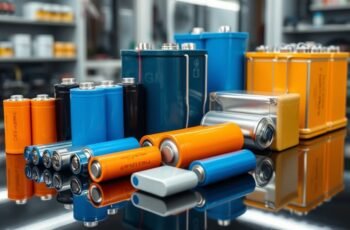
As we explore affordable lithium battery chemistries, it’s clear that selecting the right type involves balancing cost, safety, and performance. Lithium Iron Phosphate (LiFePO₄) and Lithium Manganese Oxide (LiMn₂O₄) stand out for their reliability and eco-friendliness, especially in budget-sensitive applications. Understanding their strengths and limitations is essential for making informed choices that meet both technical and economic requirements—an analysis that can markedly influence your project’s success.
Key Takeaways
- Lithium Iron Phosphate (LiFePO₄) batteries are cost-effective, offering safety and long cycle life.
- Lithium Manganese Oxide (LiMn₂O₄) batteries provide affordable, eco-friendly, and thermally stable energy storage.
- NMC batteries balance high energy density with reasonable costs, suitable for large-scale applications.
- Choosing chemistries with lower cobalt content reduces material costs and environmental impact.
- Consider safety, longevity, and recycling factors to select the most affordable and sustainable lithium battery option.
Understanding the Different Types of Lithium Battery Chemistries
Understanding the different types of lithium battery chemistries is essential for selecting the appropriate technology for specific applications. Each chemistry offers distinct advantages and challenges, particularly regarding battery safety and recycling considerations. Lithium-ion variants like NMC (Nickel Manganese Cobalt) provide high energy density but require rigorous safety management to prevent thermal runaway. Conversely, LFP (Lithium Iron Phosphate) batteries emphasize inherent thermal stability, reducing safety risks, but pose different recycling challenges due to their chemical composition. Recognizing these differences helps us assess long-term environmental impacts and safety protocols. Optimizing battery selection involves balancing performance with responsible disposal practices, ensuring that safety measures are integrated throughout the lifecycle. This understanding enables more informed choices aligned with both operational needs and sustainability goals.
Cost-Effective Lithium Iron Phosphate (LiFePO₄) Batteries for Budget-Friendly Power
Lithium Iron Phosphate (LiFePO₄) batteries have gained prominence as a cost-effective option for applications requiring reliable power without the premium price tag of other lithium chemistries. Their stable chemistry offers enhanced safety, longer cycle life, and better thermal stability, making them suitable for budget-conscious projects. From an environmental perspective, LiFePO₄ batteries are advantageous due to their lower toxicity and more straightforward battery recycling processes, which reduce ecological impact. Their recyclability minimizes waste and resource depletion, contributing to sustainable energy systems. While initial costs are competitive, their durability extends operational lifespan, decreasing replacement frequency. Overall, LiFePO₄ batteries balance affordability with environmental responsibility, making them an attractive choice for those prioritizing both cost savings and ecological considerations.
Exploring Lithium Manganese Oxide (LiMn₂O₄) Batteries and Their Practical Uses
Building on the conversation about cost-effective lithium chemistries, Lithium Manganese Oxide (LiMn₂O₄) batteries offer a compelling balance of performance and safety. These batteries are valued for their high thermal stability, reducing the risk of thermal runaway. Their practical uses span power tools, electric vehicles, and grid storage, where safety and cycle life are essential. Additionally, LiMn₂O₄ batteries are more environmentally friendly due to easier battery recycling processes and lower cobalt content.
LiMn₂O₄ batteries offer a safe, eco-friendly, and cost-effective solution for diverse energy storage needs.
Key points include:
- Enhanced safety profile, minimizing fire hazards.
- Lower environmental impact through sustainable recycling.
- Cost efficiency, making them attractive for broad applications.
- Moderate cycle life, suitable for short- to medium-term use.
Their practical applications highlight a promising, eco-conscious alternative in affordable energy storage.
Advantages of Lithium Nickel Manganese Cobalt Oxide (NMC) Chemistries for Affordable Energy Storage
Lithium Nickel Manganese Cobalt Oxide (NMC) batteries present a versatile and cost-effective solution for affordable energy storage due to their high energy density and balanced performance characteristics. Their composition enables a favorable trade-off between capacity and stability, extending battery longevity through optimized chemistry. This results in longer cycle life, reducing replacement frequency and overall costs. Additionally, NMC chemistries tend to have a lower environmental impact compared to other lithium-ion options, as their balanced metal content minimizes resource extraction and waste. The inherent stability of NMC batteries also enhances safety and reliability, making them suitable for large-scale applications. Overall, their combination of high energy density, durability, and reduced environmental footprint makes NMC chemistries an attractive choice for sustainable, affordable energy storage solutions.
Choosing the Right Lithium Chemistry for Your Needs: Key Factors and Recommendations
Selecting the most suitable lithium chemistry depends on a thorough assessment of your application needs, including energy density, safety, cost, and environmental impact. To optimize these factors:
- Prioritize safety considerations, ensuring the chemistry minimizes risks like thermal runaway and is compatible with battery recycling processes.
- Evaluate energy density to match your power requirements without compromising longevity.
- Consider cost-effectiveness, factoring in initial investment and long-term maintenance, including recycling viability.
- Assess environmental impacts, choosing chemistries with reduced ecological footprint and improved sustainability profiles.
Frequently Asked Questions
How Do Lithium Battery Chemistries Impact Overall Device Lifespan?
Lithium battery chemistries considerably influence device lifespan through battery longevity and chemistry stability; more stable chemistries reduce degradation rates, extending overall device life, while less stable ones accelerate capacity loss, highlighting the importance of choosing ideal chemistry for durability.
Are There Safety Concerns Associated With Different Lithium Chemistries?
Safety concerns vary with lithium chemistries, but advancements in battery manufacturing and chemistry have greatly mitigated risks. We analyze these developments to guarantee safer, cost-effective solutions, emphasizing the importance of ongoing research for ideal device protection.
Which Lithium Chemistry Offers the Best Environmental Sustainability?
We believe lithium iron phosphate (LiFePO4) offers the best environmental sustainability due to its use of eco-friendly materials, longer cycle life, and safer, more sustainable energy storage, reducing environmental impact throughout its lifecycle.
How Do Temperature Variations Affect Various Lithium Battery Types?
Temperature variations considerably impact lithium battery types; thermal management is vital for maintaining temperature stability, preventing capacity loss, and ensuring safety. Different chemistries respond uniquely to temperature shifts, emphasizing the importance of proper cooling and heating systems.
Can Affordable Lithium Chemistries Be Recycled Efficiently?
Recycling affordable lithium chemistries is like opening a vault—recycling processes are advancing, making them chemically recyclable. While challenges exist, ongoing innovations enhance efficiency, promising a future where cost-effective, sustainable lithium battery reuse becomes standard.
Conclusion
Ultimately, selecting the right lithium battery chemistry is like tuning a finely crafted instrument—each type offers unique tonal qualities suited to specific needs. By understanding their strengths, safety profiles, and cost factors, we can optimize our energy solutions for performance and sustainability. Just as a skilled musician chooses the right strings for their sound, we must choose the chemistry that best aligns with our application, ensuring reliable, eco-friendly power that resonates with our goals.