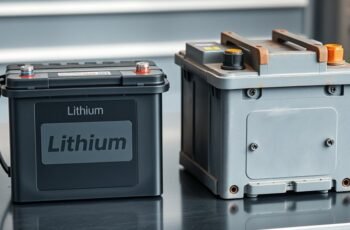
When evaluating 100AH LiFePO4 batteries, it’s essential to analyze key performance metrics such as capacity stability, cycle life, and safety features, which directly influence long-term reliability. Variations in design, BMS technology, and physical specifications can markedly impact system integration and overall cost-effectiveness. As we compare top brands, understanding these technical differences becomes vital to making an informed choice that balances performance with sustainability—an aspect often overlooked but essential for ideal application.
Key Takeaways
- Compare cycle life, capacity retention, and thermal stability to evaluate overall durability and performance differences among 100AH LiFePO4 batteries.
- Assess physical dimensions, weight, and connector compatibility to ensure proper fit and system integration.
- Review brand reputation, quality standards, and user feedback for reliability and long-term consistency.
- Consider pricing, warranty, and maintenance costs to determine the best value and investment longevity.
- Examine safety features like BMS protection, environmental impact, and recycling options for eco-friendly and secure operation.
What Is a 100AH LiFePO4 Battery and Why Is It Popular?
A 100AH LiFePO4 battery is a lithium iron phosphate energy storage unit designed to deliver a reliable and high-capacity power source for various applications. Its popularity stems from superior cycle life, thermal stability, and safety features, making it suitable for renewable energy systems and portable devices. From an environmental perspective, LiFePO4 batteries have a lower overall environmental impact due to their stable chemistry and reduced risk of thermal runaway. Additionally, battery recycling processes for these units are advancing, allowing for the recovery of valuable materials and minimizing waste. This combination of durability, safety, and eco-friendliness explains why the 100AH LiFePO4 battery continues to gain favor among consumers seeking sustainable energy solutions.
Key Factors to Consider When Choosing a 100AH LiFePO4 Battery
When selecting a 100AH LiFePO4 battery, we must evaluate its lifespan and durability to guarantee long-term performance. Compatibility and size fit are also critical to integrate the battery seamlessly into existing systems. By analyzing these factors, we can identify options that optimize both reliability and application-specific requirements.
Battery Lifespan and Durability
Evaluating the lifespan and durability of a 100AH LiFePO4 battery is essential for ensuring long-term performance and cost-effectiveness. These batteries typically offer 2000-5000 charge cycles, markedly outperforming lead-acid options. Durability depends on factors like cell quality, thermal management, and proper usage. A longer lifespan reduces the frequency of replacements, positively impacting the environment by lowering waste and supporting sustainable practices such as battery recycling. Properly designed LiFePO4 batteries minimize degradation, maintaining capacity over time and decreasing environmental impact. Manufacturers that emphasize durability often incorporate advanced cell chemistry and robust casing materials, ensuring resilience against thermal and mechanical stress. Ultimately, selecting a battery with proven longevity benefits both operational efficiency and environmental responsibility.
Compatibility and Size Fit
Evaluating compatibility and size fit is fundamental to guaranteeing that a 100AH LiFePO4 battery integrates seamlessly into existing systems. Proper sizing prevents installation issues and ensures ideal performance. Compatibility extends beyond physical dimensions, encompassing voltage, connector types, and system requirements. A mismatch can hinder battery recycling processes or increase environmental impact due to improper disposal. Here’s a quick comparison:
| Feature | Specification |
|---|---|
| Dimensions | 12” x 6” x 8” |
| Connector Type | MC4, Anderson, or custom |
| Voltage Compatibility | 12V, 24V, or 48V systems |
Matching these factors minimizes environmental impact and supports sustainable battery recycling.
Comparing Top Brands: Performance and Durability of 100AH LiFePO4 Batteries
Top brands in the 100AH LiFePO4 battery market demonstrate notable differences in performance metrics and durability. Variations in battery aesthetics influence user integration, with sleek designs often correlating with enhanced build quality. Durability assessments reveal disparities in cycle life and resistance to thermal stress, impacting long-term reliability. Performance metrics, such as capacity retention under various loads, vary substantially across brands. Key factors include adherence to standardized charging protocols, which guarantee ideal lifespan and safety. To evaluate top contenders, consider:
Top brands vary in performance, durability, and design, emphasizing the importance of standardized charging and cycle life for reliable use.
- Consistency in capacity degradation over cycles
- Structural integrity and aesthetic quality
- Compliance with industry-standard charging protocols for longevity
These factors collectively determine a brand’s overall performance and durability, guiding informed selection for demanding applications.
How Do Battery Management Systems (BMS) Impact Your 100AH LiFePO4 Choice?
Battery management systems (BMS) directly influence the safety, longevity, and operational efficiency of 100AH LiFePO4 batteries. They guarantee critical safety features, optimize battery lifespan, and provide real-time monitoring and alerts. Understanding these functions helps us select a BMS that aligns with our performance and reliability requirements.
Safety Features Integration
Because safety is paramount when selecting a 100AH LiFePO4 battery, the role of the Battery Management System (BMS) cannot be overstated. A well-designed BMS guarantees proper cell balancing, over-voltage, and over-current protection, directly impacting the battery’s safety features integration. This safeguards against thermal runaway and potential fires, critical for minimizing environmental impact and facilitating battery recycling.
Key functions include:
- Cell Balancing: Maintains uniform voltage, prolonging lifespan and enhancing safety.
- Protection Protocols: Prevents overcharge, deep discharge, and short circuits, reducing failure risks.
- Monitoring Systems: Provides real-time data for safe operation and environmental compliance, supporting responsible disposal and recycling practices.
Battery Life Optimization
A well-designed Battery Management System (BMS) directly influences the longevity and performance of a 100AH LiFePO4 battery by ensuring ideal operational conditions. It accurately monitors voltage, current, and temperature, preventing overcharging and deep discharging that accelerate battery degradation. Effective BMS integration optimizes cycle life and enhances overall efficiency, reducing premature replacements. This, in turn, positively impacts battery recycling efforts by extending the usable lifespan and minimizing waste. Additionally, a robust BMS supports environmentally conscious practices by maintaining battery health, lowering the environmental impact associated with frequent replacements. Precise management of charge cycles and temperature also preserves battery capacity over time, ensuring consistent performance and reducing the ecological footprint of battery disposal. Therefore, a reliable BMS is essential for maximizing lifespan and sustainability in 100AH LiFePO4 applications.
Monitoring and Alerts
How considerably a Battery Management System (BMS) can influence your choice of a 100AH LiFePO4 battery often hinges on its monitoring and alert capabilities. A robust BMS enables remote monitoring, providing real-time data on voltage, current, and temperature, which is critical for maintaining battery health. It also offers alert notifications that proactively warn users of potential issues like overcharge, over-discharge, or thermal anomalies, preventing damage and extending lifespan.
Key factors include:
- Data Accuracy and Frequency — Ensures reliable insights for timely intervention.
- Communication Protocols — Compatibility with remote monitoring platforms enhances oversight.
- Alert Customization — Allows tailored notifications based on specific parameters, improving responsiveness.
These features substantially impact operational safety and battery longevity, making monitoring and alert functions essential in BMS selection.
Weight, Size, and Portability: Finding the Right Fit for Your Application
Selecting the appropriate 100AH LiFePO4 battery requires careful consideration of weight, size, and portability to guarantee it aligns with your specific application. A well-designed portable design minimizes weight without sacrificing capacity, enabling easier integration into compact systems. Weight reduction is achieved through advanced cell chemistry and optimized casing materials, which enhance portability while maintaining structural integrity. Smaller form factors facilitate installation in tight spaces, essential for mobile or space-constrained setups. We assess these parameters to assure the battery’s physical profile supports stability and ease of handling. Ultimately, balancing weight and size enables us to choose a battery that provides reliable power while offering the portability necessary for diverse applications, from RVs to off-grid systems.
Cost and Value: Which 100AH LiFePO4 Battery Offers the Best Investment?
While upfront cost is a critical factor, evaluating the overall value of a 100AH LiFePO4 battery requires analyzing long-term performance, lifespan, and maintenance expenses. Battery aesthetics can influence installation and integration, but their impact on value is minimal compared to durability. Cost-effective options often feature straightforward charging procedures, reducing operational complexity. To determine the best investment, consider these factors:
- Lifespan and cycle life: Longer-lasting batteries lower replacement costs.
- Charging procedures: Efficient, compatible charging protocols reduce energy waste and extend battery health.
- Aesthetic design and build quality: Well-designed units facilitate installation and maintenance, adding value beyond initial price.
A balanced assessment of these elements ensures selecting a battery that offers peak performance and long-term savings.
User Reviews and Real-World Performance Insights
User reviews and real-world performance data provide invaluable insights that complement technical specifications and cost analyses. Users frequently highlight how 100AH Lifepo4 batteries perform under varying loads and environmental conditions, revealing consistency in capacity and efficiency over time. Many emphasize the importance of battery recycling, noting how well manufacturers support environmentally responsible disposal and recycling practices, which directly impact the battery’s overall environmental impact. Feedback also points to rapid charge times and stable discharge curves, essential for reliable applications. While some concerns about initial setup or compatibility arise, these are outweighed by the benefits of reduced environmental footprint and sustainable recycling options. Overall, real-world insights solidify Lifepo4 batteries as environmentally conscious choices with predictable, dependable performance.
Longevity and Maintenance: Ensuring Your Battery Lasts for Years
Maintaining the longevity of a 100AH Lifepo4 battery requires a proactive approach to proper usage and regular upkeep. Consistent monitoring of voltage and temperature prevents stress that shortens lifespan. Proper charging practices, such as avoiding overcharge and deep discharge, optimize cycle life. Additionally, responsible battery recycling minimizes environmental impact, ensuring sustainable disposal after its service life.
Key maintenance steps include:
- Implementing balanced charging to prevent cell imbalance.
- Conducting periodic capacity checks to identify degradation early.
- Ensuring environmental conditions remain within manufacturer-specified ranges to reduce thermal stress.
Compatibility and Integration With Your Power System
Ensuring your 100AH Lifepo4 battery seamlessly integrates with your power system requires careful assessment of compatibility factors such as voltage, current ratings, and communication protocols. Proper alignment of charging protocols is essential to prevent overcharging or undercharging, which can compromise battery lifespan and system stability. Compatibility with existing inverter and battery management systems (BMS) ensures efficient communication and monitoring. Additionally, evaluating the environmental impact involves selecting batteries with sustainable manufacturing practices and recyclability. A thorough understanding of these technical parameters guarantees peak performance and safety. Integrating a compatible Lifepo4 battery not only enhances system efficiency but also minimizes ecological footprint by adhering to eco-friendly standards. This guarantees a robust, reliable, and sustainable power solution tailored to your specific needs.
Making the Final Decision: Tips for Choosing the Best 100AH LiFePO4 Battery
When selecting the ideal 100AH LiFePO4 battery, we focus on chemistry and manufacturing quality to guarantee reliability and performance. Cost, warranty coverage, and support options also influence long-term value, while compatibility with your system dictates proper integration. By systematically evaluating these factors, we can identify the battery that best aligns with your specific application needs.
Battery Chemistry and Quality
Selecting a high-quality 100AH LiFePO4 battery begins with understanding its chemistry and manufacturing standards, as these directly influence performance, safety, and longevity. The core factor is battery chemistry, which determines stability, cycle life, and thermal management. Ensuring rigorous quality assurance processes is critical to verifying consistent manufacturing standards.
Key considerations include:
- Use of proven lithium iron phosphate chemistry, known for stability and safety.
- Strict adherence to quality assurance protocols, including cell balancing and safety testing.
- Certification from reputable standards organizations, ensuring reliability and compliance.
Pricing and Warranty Options
How do pricing and warranty options influence our choice of the most suitable 100AH LiFePO4 battery? Pricing reflects the balance between initial investment and long-term value, often tied to charging speed and durability. A higher upfront cost may indicate superior build quality, enhancing charging efficiency and lifespan, reducing environmental impact over time. Warranty coverage is vital, as it demonstrates manufacturer confidence and offers protection against early failures, ensuring sustained performance. Batteries with extensive warranties often have better quality controls, supporting consistent charging speed and minimizing environmental impact through reliable operation. Consequently, evaluating both pricing and warranty options helps us identify a battery that not only meets technical requirements but also optimizes overall lifecycle costs and ecological footprint.
Compatibility and Application Needs
Ensuring compatibility between a 100AH LiFePO4 battery and your specific application is essential for peak performance and safety. Key considerations include matching charging protocols to prevent overvoltage or undercharging, which can degrade battery life. Additionally, evaluating environmental impact is critical; selecting batteries with eco-friendly manufacturing and disposal processes minimizes ecological footprint. To optimize compatibility, consider:
- Compatibility with your existing electrical system and voltage requirements.
- Adherence to appropriate charging protocols, ensuring safe and efficient charge cycles.
- Environmental sustainability, focusing on the battery’s lifecycle and recyclability.
Frequently Asked Questions
How Does Temperature Affect 100AH Lifepo4 Battery Performance?
Temperature greatly impacts our 100AH Lifepo4 batteries’ performance, as thermal stability declines outside ideal ranges. Effective temperature regulation guarantees consistent power output and prolongs lifespan by minimizing performance fluctuations caused by extreme heat or cold.
Can 100AH Lifepo4 Batteries Be Connected in Series or Parallel?
We can connect 100Ah LiFePO4 batteries in series to increase voltage, or in parallel to maintain voltage while boosting capacity, ensuring proper matching of battery capacity and voltage compatibility for safe, efficient system performance.
What Safety Precautions Should Be Taken With 100AH Lifepo4 Batteries?
We guarantee safety by maintaining proper battery insulation to prevent short circuits and minimize fire risk, regularly inspecting connections, avoiding overcharging, and adhering to manufacturer guidelines, thereby reducing hazards and promoting reliable, safe operation of 100Ah LiFePO4 batteries.
How Do Charging Cycles Impact Battery Lifespan?
We’ve seen that improper charging protocols accelerate battery degradation, reducing lifespan. For example, frequent shallow cycles can preserve longevity, but overcharging or deep discharges cause faster capacity loss, highlighting the importance of proper charging for peak battery health.
Are 100AH Lifepo4 Batteries Environmentally Friendly?
We find 100Ah Lifepo4 batteries environmentally friendly due to their long lifespan, lower toxicity, and recyclability, aligning with environmental regulations and encouraging responsible battery recycling, which minimizes ecological impact and promotes sustainable energy solutions.
Conclusion
Choosing the right 100AH LiFePO4 battery is like finding the perfect puzzle piece—each factor from capacity to BMS integration must align seamlessly. By analyzing performance, durability, and environmental impact, we can optimize our energy systems for reliability and sustainability. Making an informed decision guarantees your investment serves as a solid foundation, powering your needs efficiently and safely for years to come. Ultimately, it’s about building a future that’s both robust and eco-conscious.