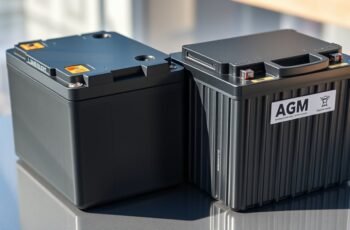
When comparing lithium-ion and LiFePO4 batteries, it’s essential to understand how their chemistry impacts performance, safety, and longevity. Each type offers distinct advantages for specific applications, but choosing the right one depends on evaluating factors like thermal stability, cycle life, and cost over time. As we analyze these differences, you’ll see why selecting the appropriate battery isn’t just a matter of capacity but involves a nuanced assessment of long-term value and safety considerations.
Key Takeaways
- LiFePO4 offers superior thermal stability and safety, with lower risk of thermal runaway compared to lithium-ion batteries.
- Lithium-ion batteries have higher energy density, making them suitable for portable electronics and EVs requiring compact design.
- LiFePO4 has a longer cycle life (over 2,000 cycles) and better longevity, reducing replacement and maintenance costs.
- Lithium-ion batteries involve complex manufacturing and recycling processes, whereas LiFePO4 uses simpler, environmentally friendlier materials.
- Cost-wise, LiFePO4 may be higher initially but is more cost-effective long-term due to its durability and safety benefits.
How Do Lithium-Ion and LiFePO4 Batteries Differ in Chemistry?
While both lithium-ion and LiFePO4 batteries utilize lithium-based chemistries, their fundamental differences lie in their cathode materials, which markedly impact electrochemical behavior. Lithium-ion batteries typically use cobalt, nickel, or manganese oxide cathodes, enabling higher energy density but complicating manufacturing processes and recycling efforts. Conversely, LiFePO4 batteries employ iron phosphate, offering enhanced thermal stability and longer cycle life. The cathode composition influences manufacturing complexity, with lithium-ion chemistries requiring more sophisticated processes to guarantee safety and performance. Additionally, the choice of cathode affects battery recycling, as cobalt-based chemistries pose environmental and ethical challenges, while iron phosphate simplifies recycling pathways. These chemical distinctions underpin each battery type’s performance, safety, and sustainability profiles, shaping their respective manufacturing and end-of-life management strategies.
Which Battery Type Offers Better Safety and Thermal Stability?
When comparing safety and thermal stability, we focus on the risks of thermal runaway, fire resistance, and the structural safety features inherent in each battery type. LiFePO4 batteries generally demonstrate lower thermal runaway tendencies and better fire resistance due to their stable chemistry. Analyzing these factors helps determine which battery offers superior safety in demanding applications.
Thermal Runaway Risks
Li-ion batteries and LiFePO4 batteries differ markedly in their thermal stability and propensity for thermal runaway, a critical safety concern. LiFePO4’s stable chemistry provides a considerably lower risk of thermal runaway due to its resilient crystal structure. In contrast, traditional lithium-ion cells, with their layered cathode materials, are more prone to overheating during faulty battery manufacturing or abuse. The safety advantage of LiFePO4 extends to recycling processes, where less hazardous materials reduce risks.
Consider these critical points:
- Reduced ignition risk during thermal runaway
- Greater resistance to overheating and short circuits
- Lower likelihood of catastrophic failure
- Safer handling in abusive conditions
- More sustainable disposal due to stable chemistry
Fire Resistance Levels
LiFePO4 batteries demonstrate superior fire resistance compared to traditional lithium-ion cells, owing to their inherently stable chemistry and robust crystal structure. This stability reduces the risk of thermal runaway, making them safer under extreme conditions. During battery manufacturing, the inherent chemical properties of LiFePO4 minimize the likelihood of combustion or fire initiation. Additionally, their thermal stability contributes to safer recycling processes, as they are less prone to overheating or combustion during disposal. In contrast, standard lithium-ion batteries with cobalt or nickel-based chemistries are more vulnerable to fire hazards due to less stable electrode materials. Overall, LiFePO4’s fire resistance not only enhances safety during use but also simplifies handling and recycling, underscoring their advantage in applications demanding high thermal stability and safety.
Structural Safety Features
The structural safety features of batteries markedly influence their overall thermal stability and risk profile, with LiFePO4 batteries offering distinct advantages over traditional lithium-ion cells. Their robust crystal structure enhances thermal stability during battery manufacturing, reducing the risk of thermal runaway. Additionally, LiFePO4’s inherent chemical stability minimizes the likelihood of fires or explosions. These safety benefits extend through recycling processes, where LiFePO4’s stability simplifies handling and disposal. By contrast, traditional lithium-ion cells, with more sensitive cathode materials, pose higher safety risks. The design of LiFePO4 cells also contributes to their resilience under mechanical stress. Overall, the combination of chemical, structural, and manufacturing factors makes LiFePO4 batteries a safer choice for diverse applications.
- Feel secure knowing your battery is less prone to catastrophic failure
- Trust in safer recycling processes that protect both environment and users
- Rely on stable chemistry for long-term safety and durability
- Experience enhanced resistance to thermal incidents
- Benefit from safer battery manufacturing standards and practices
How Do Their Performance and Longevity Compare?
While both lithium-ion and LiFePO4 batteries are popular choices for energy storage, their performance and longevity differ markedly due to underlying chemical properties. Lithium-ion batteries typically offer higher energy density, enabling more compact designs, but their manufacturing processes can introduce variability impacting lifespan. In contrast, LiFePO4 batteries generally have lower energy density but exhibit superior cycle life and thermal stability, extending their operational longevity.
| Property | Lithium-ion | LiFePO4 |
|---|---|---|
| Energy Density | Higher | Lower |
| Cycle Life | 500-1,000 cycles | 2,000+ cycles |
| Manufacturing Complexity | More complex | Simpler |
| Thermal Stability | Moderate | Excellent |
| Longevity | Moderate | Longer |
These differences highlight trade-offs between initial performance and long-term durability.
Which Battery Is More Cost-Effective Over Time?
Evaluating cost-effectiveness over time requires examining how initial investment, operational expenses, and lifespan influence overall value. Lithium-ion batteries typically have higher upfront costs but offer greater energy density, enabling more efficient storage per unit volume. Lifepo4 batteries often cost less initially and excel in safety and longevity, reducing replacement frequency. Over their lifespan, factors like battery recycling become essential—Lifepo4’s stable chemistry simplifies recycling, potentially lowering long-term disposal costs. While lithium-ion batteries may deliver superior performance initially, their shorter cycle life can escalate total ownership costs. The decision hinges on balancing upfront costs against operational savings, considering energy density needs, safety, and recyclability. Ultimately, Lifepo4 batteries tend to be more cost-effective over time due to durability and lower lifecycle expenses.
What Are the Best Use Cases for Lithium-Ion vs. LiFePO4 Batteries?
What makes lithium-ion and LiFePO4 batteries suitable for different applications depends on their distinct characteristics and performance profiles. Lithium-ion batteries excel in portable electronics and electric vehicles due to their high energy density and rapid charge capabilities, making them ideal for mobility-focused uses. Conversely, LiFePO4 batteries are better suited for stationary energy storage and solar systems, given their thermal stability and longer cycle life. Manufacturing processes influence their sustainability; LiFePO4 batteries are generally easier to recycle, reducing environmental impact, whereas lithium-ion batteries pose more challenges in battery recycling. These factors, combined with their performance traits, determine ideal use cases, with lithium-ion batteries favored in applications demanding compactness and quick energy delivery, and LiFePO4 batteries preferred for safety, longevity, and stable energy supply.
How Do Charging Requirements and Maintenance Differ?
Charging requirements and maintenance protocols differ considerably between lithium-ion and LiFePO4 batteries due to their distinct chemical compositions and electrochemical behaviors. Lithium-ion batteries typically demand precise voltage regulation and moderate charging speeds to prevent capacity loss, while LiFePO4 batteries tolerate higher charging currents, enabling faster charging without compromising safety.
- Proper monitoring of voltage and temperature is vital to guarantee safe operation.
- Regular maintenance extends battery lifespan and guarantees peak performance.
- Recycling procedures vary, with LiFePO4 batteries generally being safer and easier to recycle.
- Charging speed optimization minimizes heat buildup and prolongs battery health.
- Neglecting maintenance can lead to capacity degradation, safety risks, and reduced efficiency.
Understanding these differences helps maximize battery lifespan and supports responsible battery recycling practices.
What Are the Environmental Impacts of Each Battery Type?
Both lithium-ion and LiFePO4 batteries carry distinct environmental footprints, shaped by their material extraction, manufacturing emissions, and end-of-life handling. Lithium-ion batteries involve extensive mining of lithium, cobalt, and nickel, leading to significant ecological disturbance and higher manufacturing emissions. Their complex chemical composition complicates battery recycling, often resulting in lower recovery rates of critical materials. Conversely, LiFePO4 batteries utilize more abundant and less toxic materials, reducing environmental impact during extraction and manufacturing. Additionally, they are easier to recycle, which lessens long-term waste concerns. Overall, LiFePO4 batteries tend to have a lower environmental footprint due to less intensive resource extraction and more straightforward recycling processes. Nevertheless, both types warrant further improvements in sustainable manufacturing and effective battery recycling to minimize ecological consequences.
How Should You Choose Between Lithium-Ion and LiFePO4 for Your Needs?
When selecting between lithium-ion and LiFePO4 batteries, safety and stability are critical factors, as LiFePO4 offers higher thermal stability and lower risk of thermal runaway. Cost and longevity also influence decisions, with LiFePO4 generally providing longer cycle life despite higher initial investment. Evaluating these points in relation to your specific application guarantees an informed choice that balances performance, safety, and cost-efficiency.
Safety and Stability
Understanding the safety and stability differences between Lithium-Ion and LiFePO4 batteries is essential for making an informed choice. Lithium-Ion batteries, while widely adopted due to advanced battery manufacturing techniques, pose higher thermal runaway risks, especially under stress or damage. Conversely, LiFePO4 batteries offer superior thermal stability, reducing the likelihood of fires or explosions. Market availability influences safety considerations, as LiFePO4’s robust chemistry makes it a preferred choice in critical applications.
Key safety factors include:
- Thermal stability: LiFePO4 resists overheating better than Lithium-Ion.
- Fire risk: Lithium-Ion batteries are more prone to ignition if damaged.
- Durability: LiFePO4 exhibits enhanced stability over multiple cycles.
- Chemical stability: Less volatile in LiFePO4 due to safer cathode chemistry.
- Manufacturing standards: Stringent quality control impacts overall safety.
Cost and Longevity
Choosing between Lithium-Ion and LiFePO4 batteries largely depends on your priorities for cost efficiency and long-term performance. LiFePO4 batteries typically have higher manufacturing costs upfront but excel in longevity, often lasting 2,000-5,000 cycles, reducing replacement frequency. Conversely, standard Lithium-Ion batteries may have lower initial costs but degrade faster, impacting total cost of ownership. Recycling processes are more established for Lithium-Ion, influencing environmental costs. Consider the table below:
| Aspect | Lithium-Ion | LiFePO4 |
|---|---|---|
| Manufacturing Costs | Lower | Higher |
| Longevity | Shorter lifespan (~1,000 cycles) | Longer lifespan (~2,000-5,000 cycles) |
| Recycling | Well-developed | Emerging, more environmentally friendly |
This analysis helps balance initial expenses against long-term savings and sustainability considerations.
Frequently Asked Questions
Are There Any Differences in Recycling Processes for Lithium-Ion and Lifepo4 Batteries?
We find that recycling processes differ between lithium-ion and LiFePO4 batteries, mainly due to their chemical composition, affecting environmental impact and battery lifespan recovery. These differences influence recycling efficiency and safety, guiding improved, sustainable disposal methods.
How Do Temperature Ranges Affect the Performance of Each Battery Type?
Like a finely tuned instrument, both batteries exhibit temperature sensitivity, but Lifepo4 offers better thermal stability, maintaining performance across broader temperature ranges, whereas lithium-ion batteries are more prone to degradation outside ideal temperatures, affecting overall efficiency and safety.
Can Lithium-Ion and Lifepo4 Batteries Be Used Interchangeably in Devices?
We believe lithium-ion and Lifepo4 batteries aren’t fully interchangeable due to differences in chemistry affecting battery longevity and safety. Cost comparison shows Lifepo4 typically costs more upfront but offers longer cycle life, influencing device compatibility and overall performance.
What Are the Potential Risks of Fire or Explosion With Each Battery Type?
We recognize that battery safety and thermal stability are vital; lithium-ion batteries pose a higher risk of fire due to thermal runaway, whereas Lifepo4 batteries offer enhanced stability, reducing explosion chances, but proper handling remains essential for safety in both types.
How Do Charging Times Compare Between Lithium-Ion and Lifepo4 Batteries?
We find that Lifepo4 batteries generally offer faster charging times and more stable power delivery, making them suitable for high-demand applications, while lithium-ion batteries may take longer to charge but provide a higher energy density for extended use.
Conclusion
In summary, choosing between lithium-ion and LiFePO4 batteries hinges on specific application needs, balancing performance, safety, and cost. Importantly, LiFePO4 batteries typically last 2-3 times longer than traditional lithium-ion options, offering significant long-term value despite higher upfront costs. Considering the increasing emphasis on sustainability—since LiFePO4 batteries are easier to recycle—it’s clear that understanding these nuanced differences helps optimize both safety and efficiency in energy storage solutions.