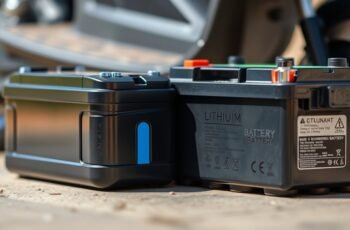
Over 2,000 charge cycles are achievable with lithium iron phosphate (LiFePO₄) batteries, a figure that markedly outperforms other chemistries. This stark difference in lifespan raises important questions about design, composition, and long-term performance. Understanding these distinctions is vital when selecting the most suitable battery for specific applications. As we explore these chemistries, you’ll see why choosing the right one can impact both durability and overall efficiency.
Key Takeaways
- Lithium iron phosphate (LiFePO₄) batteries typically last over 2,000 cycles with minimal capacity loss.
- Solid-state batteries promise over 1,500 cycles due to stable electrolytes.
- Lithium-ion batteries generally provide 500-1,000 cycles, with capacity decreasing to 70-80% after 300-500 cycles.
- High energy density chemistries like NMC may require more frequent replacements, reducing lifespan.
- Chemistry stability and thermal management significantly influence long-term durability and cycle life.
How Do Lithium Battery Chemistries Differ in Design and Composition
Although lithium battery chemistries share the fundamental principle of lithium-ion transfer, their design and composition vary considerably, influencing performance, safety, and lifespan. Electrode materials are tailored to optimize energy density and stability; for example, lithium cobalt oxide offers high capacity but less safety, while lithium iron phosphate enhances thermal stability. Electrolyte composition also varies, with liquid electrolytes, solid electrolytes, and gel polymer electrolytes each impacting ion conductivity and safety profiles. The choice of electrode materials determines the voltage window and cycle life, while electrolyte composition affects ion transport efficiency and thermal behavior. These variations directly influence how batteries perform under different conditions, dictating their suitability for specific applications and ultimately shaping their longevity and reliability.
What Is the Expected Cycle Life of Lithium-Ion, Lithium-Polymer, and Solid-State Batteries?
The expected cycle life of lithium-based batteries varies considerably based on their chemistry and design, directly impacting their durability and suitability for different applications. Lithium-ion batteries typically offer 500 to 1,000 cycles, while lithium-polymer variants tend to reach similar or slightly lower cycle counts due to their thinner electrolytes. Solid-state batteries, however, promise upward of 1,500 cycles, owing to their stable solid electrolytes. These differences influence not only performance but also cost analysis and battery recycling strategies. Longer cycle lives reduce frequency of replacement, decreasing environmental impact and costs over time. Understanding these cycle life expectations helps optimize lifecycle management, ensuring that investments in advanced battery chemistries provide maximum value and sustainability benefits in various sectors.
How Well Do These Batteries Retain Capacity Over Time?
Over time, the capacity retention of lithium-based batteries varies considerably depending on their chemistry and operating conditions. Lithium-ion batteries generally maintain around 70-80% capacity after 300-500 cycles, but factors like rapid charging speed can accelerate capacity fade. Lithium-polymer batteries often exhibit similar retention but may degrade faster under high-temperature operation. Solid-state batteries promise better long-term retention due to improved stability, yet their capacity loss still occurs gradually. Effective battery recycling practices can help mitigate capacity degradation by reducing the need for frequent replacements, therefore extending overall lifespan. Charging speed considerably influences capacity retention; faster charging tends to increase stress on the electrode materials, hastening capacity loss. Understanding these factors allows for optimized usage and recycling strategies to maximize battery lifespan.
How Do Environmental Factors Impact Battery Longevity Across Chemistries?
Environmental factors such as temperature, humidity, and mechanical stress considerably influence lithium battery longevity across different chemistries. Elevated temperatures accelerate degradation, while humidity can promote corrosion, particularly in certain electrode materials. Mechanical stresses, including vibrations and shocks, can cause structural damage that reduces overall lifespan and performance stability.
Temperature Effects on Lifespan
Temperature fluctuations considerably influence lithium battery lifespan by accelerating or decelerating chemical reactions within the cells. Proper thermal regulation minimizes these effects, maintaining ideal performance. Temperature cycling, involving repeated heating and cooling, induces mechanical stress on electrode materials, reducing cycle life. Key factors include:
- High temperatures increase parasitic reactions, causing capacity fade and faster electrolyte decomposition.
- Low temperatures impede ion mobility, leading to reduced power output and uneven aging.
- Rapid temperature changes induce thermal stress, promoting electrode degradation and potential internal damage.
Different chemistries respond uniquely—lithium iron phosphate batteries tolerate higher temperatures better, while lithium cobalt oxide cells are more sensitive. Managing environmental temperature through thermal regulation and limiting temperature cycling is essential to extend battery longevity.
Humidity and Corrosion Risks
Humidity levels considerably influence lithium battery longevity by promoting corrosion and degradation of internal components. Humidity effects vary across chemistries, with aqueous electrolytes being particularly vulnerable due to moisture’s impact on electrode stability. Elevated humidity accelerates corrosion vulnerabilities, especially at interfaces where moisture can facilitate electrochemical reactions that degrade separator materials and electrode surfaces. Lithium-ion batteries with organic electrolytes are somewhat more resistant but still susceptible to long-term humidity exposure, which can lead to dendrite formation and capacity fade. Proper sealing and environmental controls mitigate these risks, yet understanding humidity effects remains vital for predicting lifespan. Overall, controlling ambient moisture directly impacts corrosion vulnerabilities, emphasizing the importance of protective measures to preserve battery integrity and extend operational life across different chemistries.
Mechanical Stress Impact
How substantially does mechanical stress influence lithium battery lifespan across different chemistries? Mechanical deformation caused by external forces can induce stress fatigue within battery components, accelerating degradation. This impact varies markedly among chemistries:
- Lithium-ion batteries are susceptible to separator punctures and electrode delamination under repeated stress cycles.
- Solid-state batteries, while more robust, can still experience stress fatigue due to thermal expansion mismatches.
- Lithium-polymer variants face deformation-related issues, especially during mechanical shocks or bending.
Mechanical deformation compromises structural integrity, leading to increased internal resistance and potential failure. Persistent stress accelerates capacity fade, emphasizing the importance of design considerations to mitigate these effects and prolong lifespan across different lithium battery chemistries.
Which Lithium Battery Chemistry Offers the Best Performance for Long-Term Use?
When evaluating long-term performance, energy density and stability are vital factors. We analyze which chemistry maintains high capacity retention and consistent performance over extended cycles. By comparing these core metrics, we can identify the lithium chemistry that offers the most reliable durability for demanding applications.
Energy Density Advantages
Which lithium battery chemistry delivers the highest energy density for long-term applications? Lithium Nickel Manganese Cobalt Oxide (NMC) batteries lead in this regard, offering superior energy density due to their layered structure and high specific capacity. Key advantages include:
- Enhanced Storage Capacity: NMC provides up to 250 Wh/kg, supporting extended device runtimes.
- Manufacturing Innovations: Advances in electrode fabrication and electrolyte formulations boost energy density while maintaining stability.
- Sustainable Recycling: Improved battery recycling processes recover valuable materials efficiently, reducing environmental impact and supporting long-term resource availability.
These factors collectively position NMC chemistries as ideal for high-capacity, long-term use, highlighting the importance of ongoing manufacturing innovations and sustainable practices in maximizing energy performance.
Longevity and Stability
Among various lithium battery chemistries, Lithium Iron Phosphate (LiFePO₄) stands out for its exceptional long-term stability and safety profile. Its robust chemical structure resists thermal runaway, making safety considerations a key advantage. LiFePO₄ batteries typically endure over 2,000 cycles with minimal capacity loss, supporting longevity in demanding applications. Additionally, their stable chemistry simplifies battery recycling, reducing environmental impact and facilitating safer disposal. This chemistry’s inherent stability minimizes degradation over time, maintaining consistent performance. While other chemistries may offer higher energy density, LiFePO₄’s durability and safety make it a preferred choice for long-term use, especially where safety and environmental considerations are paramount. Overall, LiFePO₄’s combination of stability, safety, and recyclability establishes it as a reliable option for enduring applications.
How to Choose the Right Lithium Battery Chemistry Based on Your Needs?
Selecting the appropriate lithium battery chemistry hinges on understanding your specific application requirements and performance priorities. To optimize your choice, consider:
- Energy density and cycle life, which influence overall cost effectiveness and longevity.
- Environmental impact and battery recycling, ensuring sustainable disposal and reuse options.
- Cost considerations, balancing initial investment with long-term maintenance and replacement costs.
For applications demanding high energy density, such as portable electronics, lithium cobalt oxide (LCO) may be suitable, despite limited cycle life. For grid storage or electric vehicles prioritizing durability and cost efficiency, lithium iron phosphate (LiFePO4) offers advantages. Evaluating these factors allows for a strategic selection aligned with your sustainability goals and economic constraints.
Frequently Asked Questions
How Do Manufacturing Processes Affect Lithium Battery Lifespan?
Manufacturing processes influence lithium battery lifespan by optimizing electrode stability and electrolyte composition, reducing defects, and ensuring uniform material distribution, which minimizes degradation factors and enhances overall durability during charge cycles.
What Is the Impact of Charging Habits on Battery Longevity?
Proper charging habits, including avoiding excessive charging cycles and maintaining ideal storage conditions, considerably extend lithium battery longevity by reducing stress and degradation, ensuring more consistent performance over time and delaying capacity loss.
Are There Safety Concerns Linked to Different Lithium Chemistries?
We recognize safety concerns linked to lithium chemistries, as some pose higher battery fire risks due to chemical stability issues. Ensuring proper design and handling minimizes these risks, though chemical stability varies across different lithium battery types.
How Do Temperature Variations Influence Battery Degradation Rates?
We observe that temperature fluctuations, especially heat spikes, accelerate degradation due to reduced thermal stability and compromised temperature resilience. For example, a high-temperature test showed a 30% faster capacity loss, highlighting how thermal instability hastens battery aging.
What Advancements Are Emerging to Extend Lithium Battery Lifespan?
We’re advancing lithium battery lifespan through material innovation, enhancing electrode stability. Additionally, improved battery recycling techniques recover valuable materials, reducing degradation caused by resource depletion, and supporting sustainable, longer-lasting energy storage solutions.
Conclusion
In conclusion, understanding the nuanced differences in lithium battery chemistries helps us make informed choices for long-term applications. While LiFePO₄ offers unparalleled cycle life, solid-state batteries are promising for their durability, much like the enduring strength of medieval steel. By analyzing your specific needs—whether longevity, capacity retention, or environmental resilience—you can select the most suitable chemistry. Exploring these options guarantees your energy storage solution remains as reliable as a trusty steed through the ages.