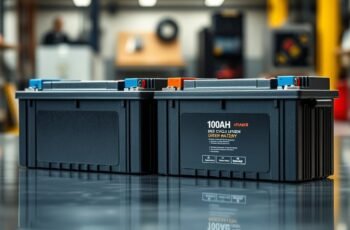
When evaluating how quickly lithium batteries can recharge, it’s crucial to take into account their chemistry, as each offers different advantages and limitations. Lithium Polymer (LiPo) batteries, for instance, are engineered for rapid charging due to their high electrode and electrolyte conductivity, enabling high current rates safely. But other chemistries, such as NMC or LiFePO₄, also have their unique charging profiles. To understand which chemistry truly charges fastest, we need to analyze their specific characteristics and operational constraints.
Key Takeaways
- Lithium Polymer (LiPo) batteries support high charge rates up to 10C, enabling faster charging compared to other chemistries.
- NMC batteries allow rapid charging due to high voltage stability and efficient ion mobility.
- Lithium Iron Phosphate (LiFePO₄) can be charged quickly with proper management, supporting fast recharge cycles.
- Lithium Cobalt (LiCoO₂) supports fast charging but generates significant heat, requiring thermal management for safety.
- NCA batteries can be fast-charged but prioritize longevity over ultra-fast recharge speeds.
Understanding Lithium Battery Chemistries and Their Charging Profiles
While lithium battery chemistries vary considerably, understanding their specific characteristics is essential for optimizing charging profiles and ensuring safety. Different chemistries influence critical factors like battery lifespan and energy density, which directly impact performance and longevity. For example, lithium cobalt oxide (LiCoO₂) offers high energy density but may degrade faster over time, reducing its overall lifespan. Conversely, lithium iron phosphate (LiFePO₄) provides a longer lifespan with lower energy density, affecting charging rates and cycle life. Recognizing these distinctions helps us tailor charging protocols appropriately, prevent overcharging, and mitigate safety risks. Essentially, a thorough understanding of each chemistry’s properties allows for maximizing efficiency while maintaining safety and durability across various applications.
How Lithium Cobalt (LiCoO₂) Batteries Charge and Their Limitations
Lithium cobalt (LiCoO₂) batteries typically charge rapidly at first but slow as they approach full capacity, which affects overall charging efficiency. During charging, heat generation increases notably, posing thermal management challenges and risking capacity loss. Additionally, these batteries have a limited number of charge cycles before capacity degradation becomes problematic.
Charging Speed Characteristics
Charging Lithium Cobalt (LiCoO₂) batteries quickly requires careful management of current and voltage to prevent damage and guarantee safety. High charging rates accelerate depletion of battery longevity, demanding precise control within safe limits. The charging infrastructure plays an essential role in enabling fast charging while maintaining battery integrity. Rapid charging typically involves higher currents, but exceeding recommended thresholds risks capacity fade and internal stress. To optimize performance, manufacturers specify maximum charging rates and voltage limits. Below is a summary of charging characteristics:
| Charging Rate | Impact on Battery Longevity | Infrastructure Requirements |
|---|---|---|
| Fast (up to 3C) | Slight reduction | High-capacity chargers needed |
| Moderate (1C) | Minimal impact | Widely compatible |
| Trickle (<0.5C) | Preserves longevity | Standard chargers |
| Ultra-fast (>3C) | Significant degradation | Specialized infrastructure |
This balance guides efficient, safe, and sustainable fast charging.
Heat Generation Issues
As lithium cobalt oxide (LiCoO₂) batteries charge, internal resistance increases, leading to significant heat generation that can limit their charging performance. This heat results from electrochemical reactions within the electrode materials, where resistive losses convert electrical energy into thermal energy. Effective thermal management is essential to prevent overheating, which can degrade electrode integrity and reduce battery lifespan. The electrode materials in LiCoO₂ batteries, especially cobalt oxide, are sensitive to temperature fluctuations, making heat dissipation critical during fast charging. Excessive heat can cause thermal runaway, posing safety risks and impairing capacity. Consequently, optimizing thermal management systems and electrode design is crucial to mitigate heat generation and enable safer, faster charging without compromising battery stability.
Limited Charge Cycles
How do lithium cobalt oxide (LiCoO₂) batteries ultimately limit their lifespan? They are constrained by their limited charge cycles, which directly impact battery longevity. Each charge and discharge cycle causes microscopic degradation of the cathode material, reducing capacity over time. This degradation accelerates if charging practices are aggressive or if the charging infrastructure is less than ideal, leading to faster capacity loss. Consequently, LiCoO₂ batteries typically sustain around 300 to 500 cycles before capacity diminishes markedly. This finite cycle count restricts their long-term use in applications demanding frequent charging. For maximum battery longevity, careful management of charge rates and infrastructure improvements are essential, ensuring batteries can sustain their performance over a greater number of cycles without premature failure.
The Fast-Charging Capabilities of Lithium Polymer (LiPo) Batteries
Lithium polymer (LiPo) batteries are engineered to support rapid charging due to their unique electrode and electrolyte structures, which allow for higher current flow without compromising safety. This design enhances charging speed while maintaining battery longevity and energy density. LiPo batteries can handle fast charge rates efficiently, making them suitable for high-performance applications requiring quick turnaround times. Their flexible form factor also facilitates integration into compact devices. To illustrate their capabilities:
| Parameter | Typical Value | Impact on Fast Charging |
|---|---|---|
| Max Charge Rate | 5C–10C | Enables rapid recharge without damage |
| Energy Density | 150–200 Wh/kg | Supports high energy storage in small sizes |
| Voltage Stability | High | Maintains safe operation during fast charge |
| Cycle Life | 300–500 cycles | Slightly reduced but acceptable for fast charging |
| Battery Longevity | Moderate | Requires proper management for extended lifespan |
This combination optimizes fast charging while balancing energy density and longevity.
Why Lithium Iron Phosphate (LiFePO₄) Batteries Are Known for Safety and Moderate Speed
Lithium Iron Phosphate (LiFePO₄) batteries are renowned for their exceptional safety profile, primarily due to their stable cathode chemistry. This stability decreases the risk of thermal runaway and fire, making them a preferred choice for applications emphasizing safety. Their moderate charging speed results from the inherent electrochemical properties, which favor consistent, reliable performance over rapid recharging. Additionally, LiFePO₄ batteries offer notable benefits in terms of battery longevity, often exceeding 2,000 charge cycles. Their environmentally friendly composition minimizes toxic waste and reduces environmental impact. Key advantages include:
- Enhanced safety due to stable chemistry
- Moderate but reliable charging rates
- Extended battery lifespan
- Lower environmental footprint
Comparing NMC and NCA Batteries: Are They Faster to Recharge?
NMC and NCA batteries exhibit distinct charging speed characteristics due to their differing chemistries, which influence ion mobility and internal resistance. Variations in electrode composition and thermal stability also affect how quickly each type can be recharged without compromising longevity. Understanding these differences is essential for optimizing application-specific charging protocols.
Charging Speed Differences
When evaluating recharge times, the chemistry of NMC (Nickel Manganese Cobalt) and NCA (Nickel Cobalt Aluminum) batteries greatly influences how quickly they can be recharged. Both chemistries exhibit distinct characteristics impacting charging speed, battery longevity, and environmental stability.
- NMC batteries generally allow faster charging due to their robust thermal stability, reducing overheating risks.
- NCA batteries tend to have slightly slower recharge rates but offer higher energy density.
- NMC’s environmental stability enhances consistent performance during rapid charging cycles.
- NCA’s chemistry favors longevity, maintaining capacity over many fast charge cycles, though it may require more careful thermal management.
Impact of Chemistry Variations
The chemistry differences between NMC and NCA batteries considerably influence their recharge rates. NMC batteries typically offer higher voltage stability, which enables faster charging without compromising safety. Conversely, NCA batteries tend to have longer battery longevity due to their stable chemistry, allowing for more charge cycles. To illustrate, consider the following:
| Feature | NMC Batteries | NCA Batteries |
|---|---|---|
| Recharge Speed | Generally faster | Slightly slower |
| Battery Longevity | Moderate | Longer |
| Voltage Stability | High | Very high |
| Impact on Charging | Supports rapid charging | Optimized for longevity |
Understanding these chemistry variations helps optimize charging strategies, balancing fast recharge capabilities with overall battery health.
Key Factors That Influence How Quickly a Lithium Battery Charges
Several factors directly impact the charging speed of a lithium battery, including its internal chemistry, design, and operating conditions. These elements influence not only how quickly a battery can recharge but also its long-term battery longevity and energy density.
Key factors include:
- Electrode Material: Materials with high ionic conductivity enable faster charge transfer, reducing charging time.
- Electrolyte Composition: Efficient electrolytes facilitate rapid ion movement, enhancing charging speed without compromising battery health.
- Charging Protocols: Proper voltage and current limits prevent overheating and degradation, balancing fast charging with longevity.
- Temperature Conditions: Ideal operating temperatures improve ion mobility, increasing charge rate while maintaining energy density and extending battery life.
Which Lithium Chemistry Is the Fastest to Recharge for Your Needs?
Different lithium chemistries exhibit varying recharge rates based on their internal structures and electrochemical properties. Lithium iron phosphate (LiFePO₄) batteries, for example, support faster charging due to their stable chemistry and robust electrochemical stability, which also enhances battery longevity. Conversely, lithium nickel manganese cobalt oxide (NMC) batteries typically require more careful management to optimize recharge speed without compromising lifespan. The choice of chemistry impacts not only recharge time but also compatibility with charging infrastructure, as some chemistries handle high current rates better. For fast charging needs, selecting a chemistry that balances rapid recharge capabilities with battery longevity is essential. Proper infrastructure, including high-current chargers, plays a vital role in maximizing recharge efficiency, especially for applications demanding quick turnaround times.
Frequently Asked Questions
Are There Specific Brands Known for Faster Lithium Battery Charging?
We find that brands like Samsung and LG optimize fast charging technology, enhancing battery lifespan and charging cycles. They employ advanced chemistries and management systems to deliver quicker charges while maintaining longevity and performance in lithium batteries.
How Does Temperature Affect Lithium Battery Charging Speed?
We find that battery temperature directly impacts charging efficiency; ideal temperatures maximize charge speed, while extreme heat or cold can slow charging or damage the cell, so maintaining proper temperature is essential for efficient lithium battery charging.
Can Fast-Charging Damage Lithium Batteries Over Time?
Fast-charging can reduce lithium batteries’ lifespan by increasing stress during charging cycles, potentially causing capacity loss over time. We recommend moderating charge rates to preserve battery health and extend overall lifespan, especially in high-frequency usage scenarios.
What Safety Precautions Are Needed for Rapid Lithium Battery Charging?
We prioritize safety during rapid lithium battery charging by ensuring proper battery insulation and adhering to strict charging protocols, balancing the risk of thermal runaway with efficient power delivery, safeguarding both device longevity and user protection effectively.
Is There a Difference in Charging Speed Between New and Aged Lithium Batteries?
We find that aged lithium batteries often have reduced charging efficiency, impacting their charging speed and battery longevity. Proper maintenance and usage can mitigate these effects, ensuring more consistent performance throughout their lifespan.
Conclusion
In conclusion, while various lithium chemistries offer unique benefits, LiPo batteries stand out for their rapid charge capabilities. Their high conductivity and design optimize quick ion transfer, making them the go-to choice for fast recharge needs. Like a race car designed for speed, LiPo’s engineering allows swift turnaround times without sacrificing safety—if managed correctly. Ultimately, selecting the right chemistry depends on balancing speed, safety, and application-specific requirements for peak performance.